
AstraZeneca Resumes Investment into UK Pharmaceutical Sector

AstraZeneca is set to inject £300m (US$408m) into the UK pharmaceutical sector, marking a significant reversal after the company suspended major capital projects in 2025.
The investment signals renewed confidence in the British market following government efforts to address pricing uncertainties and improve market conditions for pharmaceutical companies.
The Anglo-Swedish drugmaker had previously scaled back its UK commitments due to concerns over drug pricing structures and NHS access for new treatments.
However, the company has now committed funds to two strategic locations: a £200m (US$272m) expansion in Cambridge that was put on hold last year and an additional £100m (US$136m) investment in Macclesfield.
UK Prime Minister Keir Starmer described the investment as a move that will "future proof thousands of jobs". During Prime Minister's Questions on 29 April, he credited the "pharmaceutical arrangement we have struck with the United States" as a key factor enabling the commitment.
Chief Executive Pascal Soriot outlined plans to develop a "lab of the future" at the Macclesfield site, leveraging digital and data tools to accelerate drug development timelines.
In a company statement, Pascal acknowledges government efforts, saying: "We would like to thank the British government for their efforts to improve access for patients, including four new approvals since the beginning of the year across the UK.
"We look forward to further enhancing the access and the reimbursement environment and build a strong life sciences sector."

Strategic reversal after funding freeze
In September 2025, AstraZeneca halted its £200m Cambridge development alongside abandoning a £450m (US$612m) vaccine manufacturing facility investment at Speke, Merseyside. The company attributed the pause to government spending cuts, despite extended negotiations.
The decision to freeze funding represented a significant setback for the UK's pharmaceutical ambitions and raised concerns about the country's competitiveness in attracting life sciences investment.
Industry observers noted that the pause reflected broader challenges facing pharmaceutical companies operating in the British market.
The revitalised investment programme aims to create scientific positions in Macclesfield while relocating data analysis and molecular science teams to the new Rosalind Franklin office in Cambridge.
This strategic reallocation of resources demonstrates the company's commitment to consolidating its UK operations in key scientific hubs.
Susannah Streeter, Chief Investment Strategist at Wealth Club, commented on the development: "This is super encouraging and it does seem as though there is a sense of momentum returning to the pharmaceutical industry in the UK."
She described the Cambridge expansion restart as "highly symbolic" and noted it "demonstrates how the government has been working hard behind the scenes to try and make the UK more attractive to big pharma."
Strong Q1 performance drives confidence
AstraZeneca's renewed UK commitment comes alongside robust first-quarter results for 2026, with revenues climbing 8% to US$15.3bn.
Operating profit rose 12% during the same period, reflecting strong commercial execution across key therapeutic areas.
The company recorded 16% growth in its oncology division and a 15% increase in rare disease treatments, demonstrating strength in high-value segments.
In the Q1 company statement, Pascal highlighted the financial performance: "We delivered strong growth in Q1 2026, with total revenue above $15 billion, demonstrating our consistent commercial execution.
"We are advancing through our catalyst-rich period, with positive readouts for four high-value Phase III programmes since our last quarterly results, including first pivotal data for two key new molecular entities (NMEs)."
Revenue trajectory targets US$80bn by 2030
Cancer treatments now account for nearly half of AstraZeneca's total sales, positioning the company to capitalise on growing oncology markets.
The company projects several individual drugs could each generate over US$1bn in annual revenue by 2030, contributing to an ambitious target of US$80bn in total sales by the end of the decade.
During the Q1 earnings call, Pascal outlined the company's long-term financial strategy: "With a broad portfolio, a deep pipeline, and meaningful advances across multiple transformative technologies, we are well-positioned to extend growth beyond 2030."
The UK investment could support this growth trajectory by strengthening the company's research and development capabilities in key markets while securing access to British scientific talent and infrastructure.
Company portals

Executives
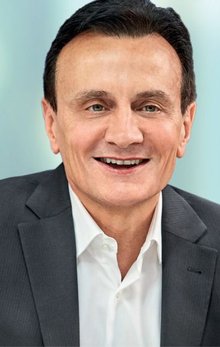
Pascal Soriot
CEO
Susannah Streeter
Chief Investment Strategist