
Could AI Help See More Women in the FinServ Workforce?

Women in financial services: crucial, essential and underrepresented.
Despite making up 42% of the workforce, there is a noticeable gap in leadership positions.
In a joint research venture, leaders from Nationwide, Bain & Company and Cambridge Judge Business School explain how AI, when adopted responsibly, could be beneficial to progression pathways for women in financial services.
According to the paper, AI could be used to close the underrepresented group, rather than reenforce existing inequalities.
AI therefore has the potential to reshape recruitment, leadership pathways and progression across the financial services sector.

The research highlights that only 8% of women are CEOs of FTSE 350 companies, despite making up 36% of leadership roles.
Recently appointed Women in Finance Champion, CEO of Nationwide Bank Dame Debbie Crosbie, is setting out to change that.
Debbie says: “AI is not just a technology choice for financial services, it is a leadership choice.
“Used well, it can help make recruitment and progression fairer, widen access to opportunity, and shine a light on talent that might otherwise be overlooked.”
Fellow Co-Authors Nishma Gosrani, Partner at Bain & Company, and Feryal Erhun, Professor of Operations and Technology Management and the Academic Director of the Wo+Men’s Leadership Centre at Cambridge Judge Business School, are making similar strides to ensure that recruitment works in favour of women where AI is involved.
Automation and the adoption gap
The paper also examines how automation affects roles by gender.
In high-earning countries, approximately 3.5% of male employment is at risk for automation.
More than double that figure (9.6%) is the proportion of female employment that is at high risk of automation.
Rather than fearing change, some employees are choosing to embrace it. A mix of cultural, organisational and behavioural factors, according to the paper, influence who engages with AI.
Men are more likely to informally engage with Gen AI, as women are much more hesitant to adopt the technology.
Feryal explains: “As AI and automation accelerate, there is a real risk that women will be disproportionately disadvantaged, but there is also a genuine strategic opportunity to reset long-standing structural inequalities.
“That is precisely why this research matters.
“The question is how to ensure that women are the architects and governors of AI in finance services.
“Our aim is that this work provides institutions with a practical blueprint for ensuring AI becomes a force that closes, rather than widens, the gender gap in financial services and provides actionable insights.”
How can the UK lead the way?
Shining light on not only the Women in Finance Charter, but also the “robust” AI regulatory framework in the UK, the paper stresses the unique opportunity presented by this combination.
Peers in the US and EU could be encouraged to follow in the UK’s footsteps as the nation combines high female board representation with what the paper terms as “emerging, principles-based” approach to AI regulation.
Nishma says: “The pace of change in financial services is unlike anything we have seen.
“Agentic AI is no longer confined to back office automation; it is moving into the front office, becoming the first touchpoint with customers and reshaping the roles of advisers, underwriters and relationship managers.
“Yet only a small fraction of firms have truly embedded it into how they operate, and fewer still can evidence the value. Closing that gap demands rigour and governance, not just ambition.
“Get it right and AI becomes a source of trust. Get it wrong and it becomes a liability.”
Looking ahead to the future, the paper predicts that CEOs, Boards and Executive Committees will need to question: how best to utilise AI, how to protect jobs from automation risk, how to close the engagement gap and female representation when these decisions are being made.
Company portals



Executives
Debbie Crosbie DBE
Chief Executive Officer

Feryal Erhun
Professor of Operations and Technology Management and the Academic Director of the Wo+Men’s Leadership Centre at Cambridge Judge Business School
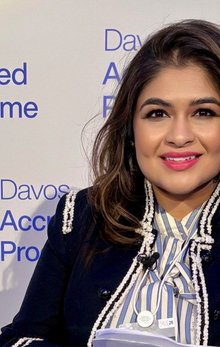
Nishma Gosrani
Partner