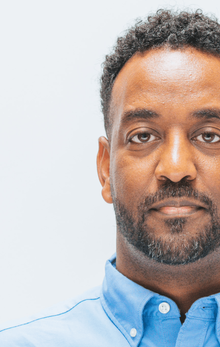
Form3’s Benyam Hagos on Investment Opportunities in the UK

Investment opportunities are sorely scoped out by CFOs and angel investors alike.
Could the secret to success be focussing on the UK?
Finance Chief sits down with Benyam Hagos, CFO of Form3, as he discusses recent trends in investing and how capital is funding more than just businesses – it’s about innovation.
Spending almost 20 years working in finance, Benyam started his career in audit, before focussing on fintech and payments. He is also the Chairman of Trust Payments in the UK.
Can you tell us a bit about the CFO role?
For me, being a CFO is about much more than managing the numbers. You need strong financial controls and discipline, particularly in a scaling business, but you also need to be commercially minded.
As the CFO, that means understanding where the opportunities for growth are, helping the business enter new markets and making sure we can clearly articulate our strategy and progress to investors.
As banks such as NatWest and Lloyds make moves to strengthen the investor market in the UK, what more do you think could be done to improve investing in British businesses?
The UK has no shortage of innovative businesses. I believe the challenge is making sure they can access the capital they need as they move from starting a business to scaling one internationally.
The British Business Bank is a great example of what can be done, but we need to see continued tax efficiencies that will further encourage investors to back British growth companies.
There is understandably a lot of focus on capital discipline today. Investors need confidence that businesses have strong controls, understand their cash position and are deploying capital responsibly.
But capital discipline cannot simply mean reducing investment. As I often say, no one shrinks to success.
Growing businesses need to be able to demonstrate what that investment is achieving, whether that is new customers, products or markets. If we want investors to back British businesses, particularly at the later stages of growth, companies also need to give them a compelling reason to stay with them for the long term.
That means being transparent about the numbers but also being able to clearly articulate the growth opportunity and what the business can become.
What is your advice to businesses in early and late stages that are looking to seek capital for innovation?
My advice would be to understand what you need the capital for and what success looks like once you have it. Raising money is not the end goal. Businesses have to be able to show how that capital translates into tangible progress for the business.
What investors expect will naturally change as a company matures. At an earlier stage, there may be more emphasis on the size of the opportunity, the strength of the product and the team behind it. As you scale, investors increasingly want evidence that you can turn that opportunity into sustainable growth.
Raising capital is ultimately about relationships. Investors are backing the management team as well as the business, and those relationships can last for many years.
Being transparent about the challenges you face is just as important as explaining the opportunity. You build credibility by demonstrating that you understand both.
- Benyam Hagos is Chairman of Trust Payments in the UK
- Form3 was founded in 2016
- 5 billion transactions are processes globally by Form3
- 50% of British banks use Form3
- Form3 has 40+ global customers
What trends have you noticed recently?
There has been a clear shift in the way investors think about growth. A few years ago, the conversation was much more focused on how quickly a company could scale. Today, there is far greater scrutiny around burn, runway and the path towards profitability.
That does not mean businesses should stop investing in growth. The challenge is being much more deliberate about where you invest and being able to demonstrate the return.
Simply telling investors that you have reduced your burn rate is not enough. They also want to see the customers you have won, the products you have launched and the markets you are entering.
At the same time, technology is becoming more complex and increasingly critical to how businesses operate. Cloud adoption, automation and AI are creating significant opportunities, but they also create new operational demands.
As organisations become more reliant on technology, investment in the underlying infrastructure, controls and resilience needed to support it becomes increasingly important.
The cost of getting that wrong can become significant, particularly in financial services where customers expect services to be available continuously.

Have you received any advice at the start of your career which is still true today?
One thing I learnt early in my career was the value of having people around you who will challenge and stretch you.
I’ve been fortunate to have mentors throughout my career who pushed me beyond what I thought I was ready for, and that has had a big influence on how I approach leadership today.
I also think you have to be willing to put yourself into situations where you do not necessarily have all the answers.
Moving from larger organisations into a scaling fintech reinforced that for me. There is rarely a perfect amount of information available before you have to make a decision.
The important thing is to surround yourself with intelligent people, listen to different perspectives and then be prepared to make the call.
That ability to keep learning becomes more important, rather than less, as you take on more senior roles.
Being transparent about the challenges you face is just as important as explaining the opportunity. You build credibility by demonstrating that you understand both"
Is finance on its way to being disrupted or relieved as AI is brought on board to help ease financial admin?
I see AI as an opportunity to relieve finance teams of work that does not make the best use of their time, rather than replace the role they play.
There is still a huge amount of manual and repetitive work within finance. If AI can reduce the time spent gathering information, producing routine reporting or carrying out administrative tasks, that gives finance professionals more capacity to analyse what the information means and help the business make better decisions.
That fits with the broader evolution of the CFO role. Finance is increasingly expected to be a commercial partner to the business, rather than simply reporting what has already happened. AI should help accelerate that shift.
Finance is also a control function, so adoption cannot come at the expense of governance. Businesses need to understand how AI is being used, where the information comes from and where human oversight remains necessary.
But if we get that balance right, I think AI can make finance teams significantly more effective.

Form3 partners:
Nationwide: The bank partnered with Form3 for payment processing simplicity. In 2025, Form3 also received strategic investment from Nationwide and BlackRock to further its multi-cloud SaaS capabilities. The funding builds on a long-standing partnership, commencing in 2020, when Nationwide first invested into Form3.
Lloyds Banking Group: With ties also stretching back to 2020, Lloyds has invested in Form3 and also owns a minority stake in the payments processing company. The partnership aims to develop the digital experience for customers.
Barclays: Form3 partnered with Barclays to provide non-bank financial institutions and fintechs direct technical access to the SEPA Instant Credit Transfer and SEPA Credit Transfer payment schemes across Europe, enabling faster, cloud-based Euro payments without traditional intermediary delays
Klarna: Klarna partnered with Form3 to gain direct technical access to European payment schemes via Form3's cloud platform. This enables Klarna to process SEPA Instant, Credit Transfer, and Direct Debit payments directly – improving operational efficiency, resilience, and customer experience across Europe while avoiding reliance on third-party banks.
SumUp: SumUp selected Form3 to power its UK payment infrastructure, integrating directly into UK payment schemes – such as Faster Payments – to scale its financial services, process transactions reliably and accelerate business growth.
Company portals

Executives
Benyam Hagos
Chief Financial Officer