
LCAW: Bain & Co Checks Pulse on Net Zero Goals with New Data
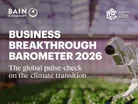
In its third iteration, the Business Breakthrough Barometer, which tracks how sectors are developing business strategies to support net zero goals, has been published.
As a collaborative effort between the World Business Council for Sustainable Development (WBCSD), the Breakthrough Agenda, the Climate High-Level Champions and Marrakech Partnership for Global Climate Action – and supported by Bain & Company – it explores through interviews, current trends and data how risk perceptions are evolving.
Further evolution studied by the report includes how corporate strategies and investments are “enabling” conditions needed to grow more private-sector investment on a global scale.
Speaking to Finance Chief exclusively, Henning Huenteler, BAIN’s partner from its Sustainability & Responsibility practice, says that for companies aiming for net zero, the report shows “companies pressing ahead, but for competitiveness rather than ambition: nearly 90% of survey respondents have maintained or increased climate investment and 38% strengthened their targets in 2025.
“Progress is more durable because it now rests on proven technologies with a clear economic case.”
He further explains that most companies already consider sustainable investment as a priority in climate strategy; for “ hard commercial reasons. 92% of surveyed companies expect their sustainability strategy to be a source of competitive advantage.
“But capital is concentrating where the economics are proven, while solutions still carrying a green premium see weaker momentum and depend more on policy support.”
Is sustainability over?
Beginning the report, Peter Bakker, President and CEO of WBCSD asks: “Is sustainability over?”
A pertinent question given the timing of the report, published at the start of London Climate Action Week.
Peter goes on to say that to this question, which he is often asked, the answer is no; however, sustainability is always changing.
He comments: “The Business Breakthrough Barometer 2026 shows that the era of sustainability driven primarily by ambition is coming to an end. What is emerging is a new, more durable phase, where sustainability is increasingly paying its way as a source of resilience and competitiveness.”
The report, which surveyed 508 companies, notes that it finds sustainability is showing resilience in the face of adversity. Despite expectations that years of geopolitical uncertainty will slow corporate investment as companies transition to a more sustainable practice, companies are actually moving forward.
Competitive advantage informs capital allocation
The Barometer highlights data that indicates capital allocation has shifted to prioritise improved resilience, among lower costs and greater supply-chain security.
Almost all business leaders (92%) say that in the next five to 10 years, sustainability is expected to become a source of competitive advantage, according to the report.
Solutions are being implemented, focusing on clean energy, electrification, regenerative architecture and circularity. New sources of growth and customer demand are also being seen as the result of solutions, such as electric vehicles and green buildings.
This, the report says, is the foundation for long-term value creation.
…the era of sustainability driven primarily by ambition is coming to an end"
The uncertainty hurdle
Businesses are facing increased costs as a result of policy volatility and geopolitical fragmentation, the report details.
Investment confidence has taken a hit as a result, with the report noting that 68% of leaders viewing a disorderly climate transition – one that is unplanned or contains poor coordination – as more likely than one year ago.
Also, the majority (98%) say a disorderly transition is viewed as a risk to all businesses, with only 15% saying they feel fully prepared.
Due to factors such as supply chain disruption, rising insurance and damaged infrastructure, the report lists that 47% of companies surveyed reported higher climate-related costs.
Policy delays could be the barrier to investment
Stronger policy is favoured by 85% of leaders. Peter notes: “...strengthening policy and action now is preferable to delaying the harder choices.”

Over half of businesses state that clarity and stability of transition policy and regulation is a key factor for investment decisions. Countries with a set policy retain more of an advantage, especially as 42% say supply chain disruptions are risked by a disorderly transition.
A further 38% warn that disruption also risks energy cost volatility, with 22% adding that there is also a risk posed for inflation and increased consumer prices.

Executives

Henning Huenteler
Partner, EMEA Carbon Markets Lead

Peter Bakker
President and CEO