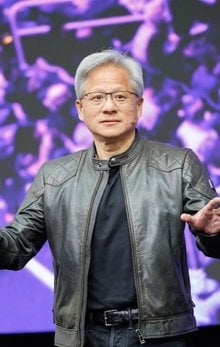
NVIDIA's Former CFO to Debut as CEO and Report Q3 Earnings

NVIDIA is set to report its third-quarter financial results after Tuesday's closing bell, marking a major leadership test for former CFO Colette Kress as she steps up to host her first investor call as interim chief executive.
Colette – who has served as the chipmaker's finance chief since 2013 – now finds herself navigating both the company's massive financial trajectory and a major, historic change to its C-suite.
When the earnings call begins, institutional analysts are expected to press Colette heavily on her strategic roadmap for maintaining operational continuity, as well as the board's timeline and criteria for the search for a permanent successor following Jensen Huang's abrupt resignation amid a personal scandal.
Discussing her expertise as a leader, Dan Ives, an analyst at Yorkville Ives & Co, praises Colette, adding that she is an appropriate pick to steady the tech giant through this uncertain period.
He adds, however, that the board would likely look outside the company for a permanent hire eventually.
- Colette Kress has served as NVIDIA's CFO since 2013, now stepping up as interim CEO following Jensen Huang's departure
- Gross margins are forecast to compress from 74% this year to 73% next year, according to Goldman Sachs, driven by rising memory and component costs
- Annual revenue is projected to surpass US$1tn by the fiscal year ending January 2030
- Net profits are expected to exceed US$500bn by the same fiscal year-end (January 2030)
- Free cash flow is projected to reach approximately US$180bn this year, underpinning NVIDIA's liquidity for working capital, foundry allocations and competitive manufacturing capacity
NVIDIA's Wall Street scrutiny
Even prior to Jensen's departure, institutional investors were questioning the durability of capital expenditure across the AI infrastructure sector.
Goldman Sachs analysts anticipate heightened scrutiny of the return on invested capital (ROIC) for AI buildouts amid a "higher-rate environment", particularly among "emerging hyperscalers and neoclouds which rely on external capital" to fund operations.
Under Jensen, NVIDIA aggressively deployed its balance sheet – acting as a credit backstop and taking direct equity stakes in customers to accelerate data centre financing.
Colette is widely expected to pivot toward stricter capital discipline, having previously pushed back against Jensen's riskier vendor-financing commitments.
Simultaneously, rising bill-of-materials (BOM) costs threaten NVIDIA's industry-leading profitability. Goldman Sachs forecasts gross margins to compress from 74% this year to 73% next year, flagging escalating memory and component costs as primary headwinds.
While some investors are concerned about how the new leadership could impact revenues, others feel it will have little effect on the wider business.
In an equity research note on the subject, Truist Securities said: "We believe the AI infrastructure spending outlook remains robust and we do not expect the CEO transition to affect customer buying patterns."

NVIDIA is going to crush estimates because demand for AI compute hasn’t gone anywhere.”
NVIDIA's next financial strategy
Despite near-term supply bottlenecks and executive transition risks, consensus forecasts suggest NVIDIA's long-term financial trajectory remains intact.
Analysts project annual revenue to surpass US$1tn by the fiscal year ending January 2030, translating into net profits exceeding US$500bn.
Underpinning this outlook is NVIDIA's formidable balance sheet.
With free cash flow projected to reach roughly US$180bn this year, the chipmaker possesses substantial liquidity to fund working capital needs, lock in foundry allocations and outspend competitors in securing constrained semiconductor manufacturing capacity.
Commenting on NVIDIA's finances amid the leadership change, Luke Lango, Chief Technology Analyst at InvestorPlace, says: "The numbers in this NVIDIA report will matter less than they ever have, and the story around it will matter more.
"NVIDIA is going to crush estimates because demand for AI compute hasn't gone anywhere."
NVIDIA partners:
TSMC: NVIDIA partners with TSMC to fabricate its next-generation AI processors, leveraging leading-edge foundry nodes and advanced packaging capabilities to meet global compute demand.
CEO: C.C. Wei | Headquarters: Hsinchu Science Park, Hsinchu, Taiwan
Microsoft: NVIDIA teams up with Microsoft to underpin Azure cloud infrastructure, pairing accelerated GPU hardware with enterprise AI software suites for customers worldwide. CEO: Satya Nadella | Headquarters: Redmond, Washington, US
Dell Technologies: NVIDIA collaborates with Dell Technologies to provide pre-validated AI factory solutions, integrating enterprise servers, storage and networking for scalable enterprise rollouts.
CEO: Michael Dell | Headquarters: Round Rock, Texas, US
Company portals


Executives

Colette Kress
Executive Vice President and CFO
Jensen Huang
Founder and Former CEO
Luke Lango
Chief Technology Analyst