
Ep. 17 | Putting the AI in ROI
Related Podcasts
AI investment is accelerating, but board expectations are changing just as quickly.
Businesses are moving beyond experimentation. Leaders now want to know where AI can reduce costs, improve productivity and deliver measurable returns.
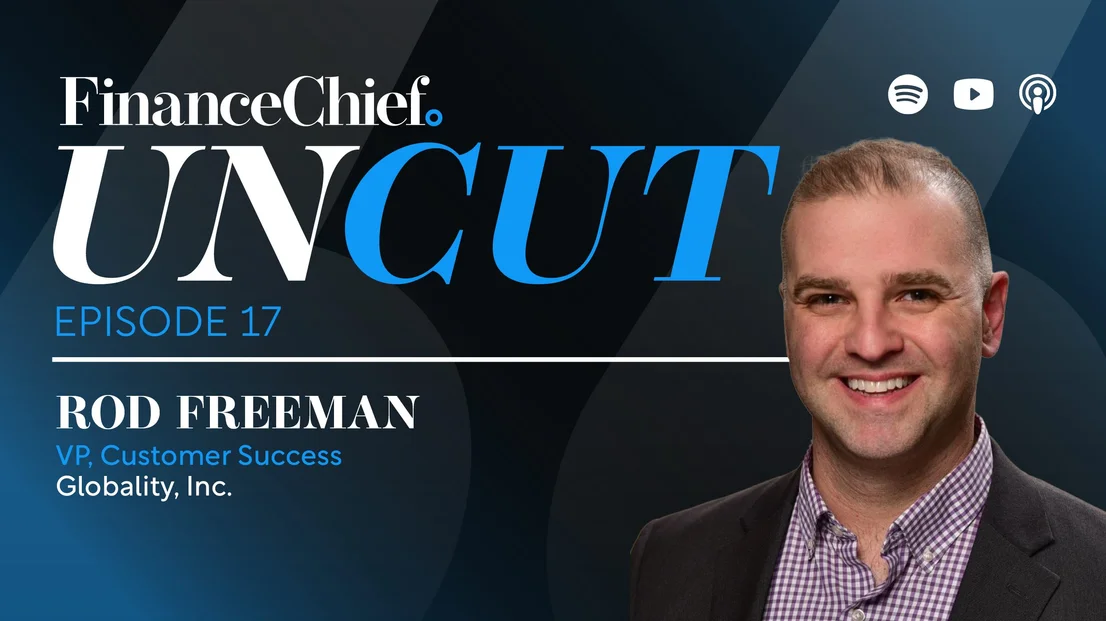
In Episode 17 of Finance Chief Uncut, host Matt High is joined by Rod Freeman, VP of Customer Success at Globality, to explore what Global 2000 organisations actually need from AI and why procurement could become one of the clearest areas for demonstrating its financial impact.
With more than 20 years of top-tier management consulting experience and work across more than 100 global organisations, Rod has helped businesses navigate large-scale transformation.
His message is simple: adopting the technology is only part of the challenge. Businesses need to rethink how they operate if they want AI to deliver meaningful value.
🎧 To listen on Spotify click here
▶️ To listen and watch on YouTube click here
🍎 To listen on Apple click here
In this episode Matt and Rod explore:
- Why boards are demanding measurable ROI from AI investment
- How AI can unlock cost savings and greater value from procurement spend
- Why finance leaders should prioritise business outcomes over AI experimentation
- How autonomous sourcing could improve efficiency and financial performance
- How AI could give finance greater visibility across spend, suppliers and commercial opportunities
- Why finance and procurement leaders need to rethink KPIs as automation becomes standard
Move from AI experimentation to results
For the past few years, much of the enterprise AI conversation has focused on pilots and experimentation.
Rod says boards are becoming increasingly impatient with that approach. Organisations are moving into an execution phase where leaders expect tangible results from AI investment.
Procurement has an advantage.
Unlike areas where ROI can be difficult to isolate, sourcing can generate measurable savings. Rod argues that a single sourcing event could potentially justify the ROI of an AI investment.
For finance leaders assessing where to prioritise AI spending, procurement therefore offers a compelling opportunity to connect technology investment directly with financial performance.
Start with the problem, not the AI
The pressure to adopt AI can encourage businesses to invest before deciding exactly what they need the technology to achieve.
Rod argues organisations should do the opposite.
Identify the problem, define the required outcome and then find the technology capable of delivering it.
The goal should not be to use AI to make existing processes slightly faster. Businesses should consider how technology can change the operating model itself.
In procurement, that could mean addressing longstanding challenges around slow sourcing processes, paperwork, limited resources and spend that organisations have historically struggled to manage.
Stop getting stuck in pilot mode
Rod takes a strong position on organisations running AI pilots without clear objectives: “Pilots are where AI goes to die.”
Testing technology without first establishing the desired business outcome can leave organisations with plenty of experimentation but little measurable value.
Instead, leaders should determine what they want to achieve and identify technology partners capable of delivering against those outcomes.
For finance leaders, this changes the AI conversation from does the technology work? to what financial or operational result did it deliver?
Understand autonomous sourcing
Autonomous sourcing goes considerably further than using AI to automate individual administrative tasks.
Rod describes a model in which AI can interpret a purchasing need, determine the best sourcing route and then execute much of that journey.
If competitive sourcing is required, AI could develop a scope of work, identify suppliers, run negotiations and create a recommendation for award, with organisations deciding where humans should intervene.
The financial implications could be significant.
Rod says Globality clients report reducing the time required to run sourcing projects by 60% to 90%, alongside double-digit savings on spend. Greater capacity also allows teams to tackle spend they previously could not reach.
For finance chiefs, the opportunity is not simply lower operating costs. It is the potential to expand the amount of spend procurement can actively optimise.
Treat AI as an operating model change
One of Rod's central arguments is that the technology itself may not be the hardest part of AI adoption.
Change management is.
Simply adding AI to an existing process risks maintaining the same inefficiencies with faster technology.
Instead, organisations need to consider how the entire process could operate differently.
For CPOs and CFOs, that means deciding where autonomous systems should operate, where humans remain involved and what new skills teams need to work effectively alongside AI.
Successful AI adoption therefore becomes an organisational transformation rather than simply another technology implementation.
Prepare for agents negotiating with agents
The next stage of autonomous procurement could see AI operating on both sides of a commercial negotiation.
Rod expects suppliers to develop their own agents, creating scenarios where buyer-side agents negotiate directly with supplier-side agents.
He also predicts that specialised agents across contracting, supplier management, spend data and market intelligence will increasingly communicate with one another and make decisions in real time.
That creates new questions for finance and procurement leaders around governance, authority, transparency and how much control businesses should give autonomous systems.
Move towards predictive sourcing
AI could eventually change not only how businesses source, but when.
Traditional sourcing often works around fixed cycles because running an event requires considerable time and resources.
Rod believes AI agents could instead continuously monitor market conditions and identify when it makes commercial sense to source.
Rather than waiting three years to revisit a category, an agent could recognise a market opportunity and recommend action – or eventually begin the sourcing process itself.
For finance leaders, this creates the possibility of a more responsive procurement function capable of identifying savings and commercial opportunities as they emerge.
Build for an autonomous future
The future Rod describes requires more than better procurement software.
Teams will need the skills to work with AI agents, understand their decisions and direct their activity. Administrative workloads could decline while strategic thinking, relationship management and commercial judgement become increasingly important.
At the same time, organisations could source more spend and gain greater visibility into their suppliers, markets and opportunities.
For finance chiefs, procurement offers a useful view of what successful enterprise AI adoption could become: technology tied to measurable financial outcomes, supported by an operating model designed around automation rather than simply adapted to it.
Explore more from Finance Chief Uncut
Catch up on Episode 16, featuring Jo Living, Founder of Aces High, exploring what poker can teach finance leaders about negotiation, calculated risk, assertiveness and high-stakes decision-making.
Company portals

Executives
Rod Freeman
VP, Customer Success | Construction and Property Category