
Ep. 19 | How Procurement Protects the Bottom Line
Related Podcasts
Procurement has a direct impact on an organisation’s financial performance, but its contribution extends far beyond negotiating lower prices.
For finance leaders, effective procurement can help control costs, reduce operational and supplier risk, strengthen governance and protect profitability.
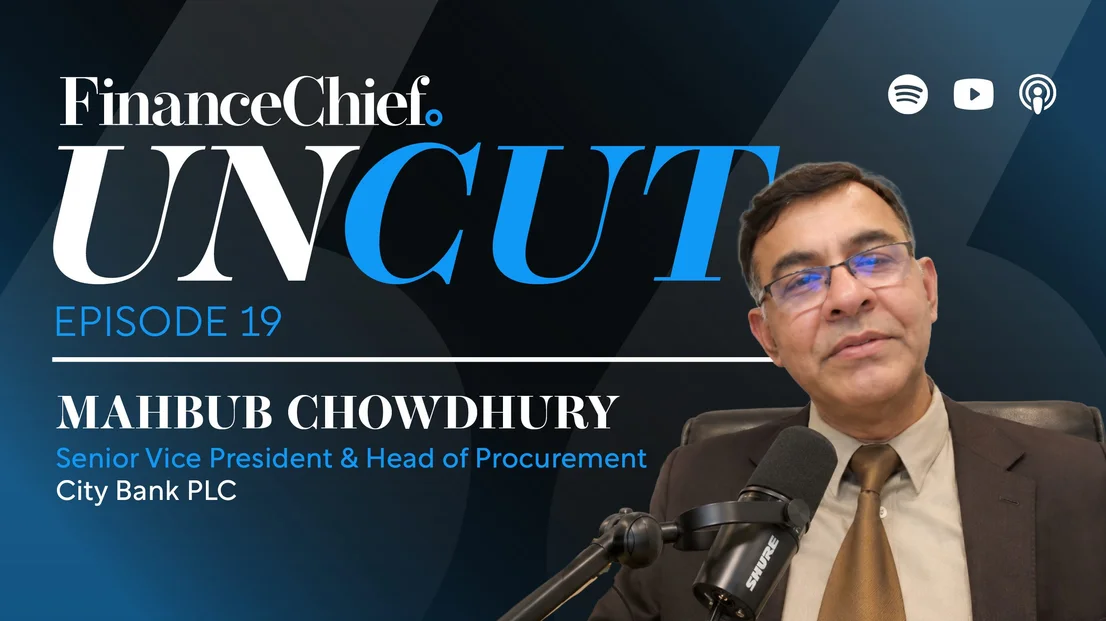
In Episode 19 of Finance Chief Uncut, Mahbub Chowdhury FCIPS, Senior VP & Head of Procurement at City Bank PLC, explores how more than 31 years in procurement and supply chain have shaped his approach to cost, efficiency and risk.
Beginning his career with a finance and accounting background, Mahbub first moved into procurement while working across cost management, budgeting and inventory control. He quickly saw the connection between procurement decisions and the bottom line.
Today, that financial perspective remains central to his approach.
Mahbub explains how City Bank has used supplier rationalisation, competition, digitalisation and process automation to increase procurement efficiency by around 20% over three years. He also explores why reducing supplier dependency and improving transparency can lower delivery and quality risks, avoiding additional costs and ultimately supporting profitability.
For financial institutions, however, cost cannot be the only consideration. Mahbub explains why regulatory compliance, vendor due diligence, data privacy, anti-money laundering requirements and cybersecurity must often take priority before cost efficiency enters the equation.
🎧 To listen on Spotify click here
▶️ To listen and watch on YouTube click here
🍎 To listen on Apple click here
In this episode:
- How Mahbub’s finance background shaped his approach to procurement
- Why procurement decisions have a direct impact on the bottom line
- How supplier competition can generate savings without relying solely on price negotiation
- How City Bank increased procurement efficiency by around 20% over three years
- Why reducing supplier dependency can lower financial and operational risk
- How governance and transparency strengthen procurement performance
- Why banking procurement must balance compliance, innovation and cost efficiency
- How digitalisation and automation can improve procurement productivity
Connect procurement with financial performance
Mahbub’s route into procurement began in finance.
With a background in accounting and cost management, he started his career working across finance, administration, budgeting and cost analysis before taking responsibility for inventory control and procurement.
That experience gave him an early view of how operational decisions affect financial performance.
Excess inventory, for example, carries a cost. Poor planning can create negative variances and reduce profitability, while more effective procurement and inventory management can improve efficiency and generate savings.
This connection between procurement and financial outcomes has remained central throughout Mahbub’s career.
Create savings through competition
For Mahbub, procurement savings should not depend solely on continually asking suppliers to reduce their prices.
Following the pandemic, his team analysed procurement data, rationalised its supplier base and created pools of multiple vendors across critical categories.
By giving capable suppliers the opportunity to compete for greater volumes of work, City Bank created a more competitive and transparent environment.
The financial benefit followed.
Rather than forcing savings through individual negotiations, Mahbub explains that competition and transparency allowed savings to emerge as a result of the procurement model itself.
Reduce risk to protect profitability
Cost savings represent only one part of procurement’s financial contribution.
Mahbub explains that diversifying the supplier base can also reduce dependency and lower delivery and quality risks.
When these risks decrease, organisations can avoid some of the additional costs associated with disruption and corrective action.
The result can feed directly into financial performance.
Through supplier transformation, digitalisation and process automation, Mahbub says his team achieved around a 20% improvement in procurement efficiency over three years, measured against changes in workload and resource requirements.
Put risk and compliance before cost
Procurement within a bank brings a different set of financial priorities.
Mahbub explains that financial institutions operate within strict regulatory environments, making procurement much more than a purchasing function.
When onboarding suppliers, teams need to consider regulatory requirements, anti-money laundering controls, data privacy, cybersecurity and vendor due diligence.
That changes the order of priorities.
While cost efficiency remains important, Mahbub argues that banking procurement must first consider risk and compliance, followed by innovation and then cost efficiency.
For finance leaders, this demonstrates why the lowest-cost supplier is not necessarily the option that creates the greatest financial value.
Use technology to increase efficiency
Digitalisation and automation also offer opportunities to improve procurement productivity.
Mahbub believes routine activities such as purchase requisitions, vendor communication and reporting will increasingly become automated as AI and digital ecosystems mature.
This could allow organisations to reduce the human resource required for transactional work while giving procurement professionals more time to focus on strategic decisions.
But technology will not remove the need for human judgement.
Mahbub argues that strategic procurement still requires people to assess value, risk and context. Technology can provide the data and insight needed to make faster decisions, but procurement leaders still need to apply their experience and judgement.
For CFOs, this creates an opportunity to view procurement not simply as a function that spends money, but as one that can protect it.
Through stronger competition, supplier diversification, governance, automation and risk management, procurement can help reduce unnecessary costs while supporting long-term financial performance.
Explore more from Finance Chief Uncut
Catch up on Episode 18, featuring James Briers, Founder and Board Member at Intelligent Delivery Solutions, exploring why data quality, governance and visibility are vital foundations for successful enterprise AI.
Company portals

Executives

Mahbub Chowdhury
Senior VP & Head of Procurement