
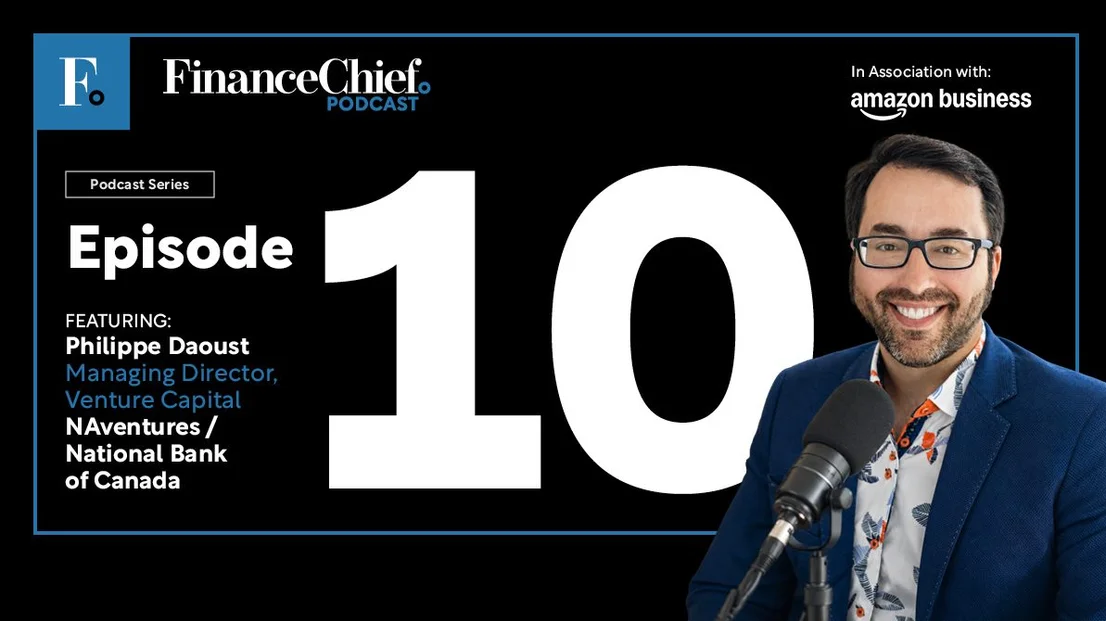
Ep. 10 | Why Most Organisations are Still Underestimating AI
Related Podcasts
While organisations are focused on adopting AI, Philippe Daoust thinks most of them are underestimating it in two very specific ways. And the cost of getting it wrong is starting to show up on the balance sheet.
In this episode of the Finance Chief Podcast, host Matt High meets with Philippe Daoust, Vice President of Innovation and Managing Director of NAventures, the corporate venture capital arm of National Bank of Canada, to discuss AI-driven embedded tools, agentic AI and the future of finance transformation. Philippe oversees a portfolio of more than 30 fintechs, has spent nearly a decade watching AI move from curiosity to core infrastructure, and brings a practical, occasionally blunt perspective to a conversation that’s moving at pace across the industry.
🎧 To listen on Spotify click here
▶️ To listen and watch on YouTube click here
In this episode we explore:
- Why AI adoption is being underestimated on deployment and cost
- How token-based pricing is changing the economics of AI at scale
- Why AI must be treated as process change, not technology change
- How CFOs can measure ROI and avoid hype-led investment
- Why HR must be central to any successful AI transformation
Why AI adoption is harder than it looks
Philippe's opening argument is specific: organisations are underestimating AI in two areas, deployment and cost, and both are causing problems.
On deployment, most businesses are still treating AI like a SaaS rollout – train the employees, hand them the tool and expect productivity gains.
But AI isn't a SaaS product. It changes how processes work, which parts of a job transfer to a machine, and what the humans around it are now supposed to do instead.
Giving employees five extra hours a week and not changing their job description, he says, just means they have five more hours to fill. That's not ROI. That's an added cost dressed up as transformation.
The cost problem finance leaders cannot ignore
Until recently, AI was easy to experiment with because the pricing made it almost painless. That's changing. As providers move from subscription to token-based models, poor usage habits become expensive quickly.
Philippe points to organisations where employees are generating far more tokens than necessary simply because nobody has taught them how to prompt efficiently.
Finance teams need to understand how AI is being consumed, what it's costing per output and whether the return justifies it. Uber, he notes, burned through an entire year's AI budget in four months – a cautionary tale about not having finance in the room when the strategy is set.
Where AI is already changing finance
For CFOs, the opportunity is real and immediate. Philippe's clearest example: a client misses their usual payment on the first of the month. An AI-connected system notices, checks whether the client has been lost, recalculates the cash flow forecast, identifies that the business will be in overdraft in 16 days and automatically proposes a margin facility.
All of this happens before the CFO has had to ask a single question. The shift from reactive to predictive financial management is significant for any size of organisation, but particularly for smaller businesses that haven't historically had the infrastructure to support that kind of real-time visibility.
Embedding AI into the business
Philippe's strongest results come from organisations that embed AI into core operations rather than bolt it on.
In banking and insurance, call centres are already seeing strong traction – the value is clear, the build versus buy debate doesn't really apply, and the ROI is measurable.
His broader philosophy on technology investment has also shifted: rather than build for 10 years or buy on five-year contracts, he now talks about renting, treating IT infrastructure like a brick wall where individual bricks can be swapped out without dismantling the whole structure.
In a world where something better appears on the market every three months, the ability to change quickly is the competitive advantage.
The CFO as AI reality check
Hope is not a strategy. Philippe is direct about the role finance leaders need to play in AI investment: challenge the cost, define the problem it's solving, understand the maintenance burden and track the return like any other capital project.
The departments in his portfolio seeing the strongest AI results are the ones that can answer three questions clearly: why did we deploy it, how does it work, and how will it evolve? The ones struggling can't. Finance's job is to make sure the organisation is doing AI to solve a real problem, not to tell the board it's doing AI.
Subscribe and Listen
Episode 10 is brought to you by Amazon Business, the one-stop destination for everything your organisation needs.
Explore More from the Finance Chief Podcast
Catch up on Episode 9, featuring Benyam Hagos, CFO at Form3 and Chairman and NED at Trust Payments, discussing payments infrastructure, real-time payments and strategic finance leadership.
Company portals


Executives

Philippe Daoust
Managing Director for NAventures, the corporate venture capital arm of National Bank of Canada